|
Author |
TOPIC: pickles and a+ |
|
| Smitty
October 4, 2007
3:44:38 PM
Entry #: 2402360
| if your name has anything to do with pickles or you play for or were once involved with aplus, please post here.
this way the rest of us don't have to read your 5 different topics to fight over nothing. you have earned your own little corner of the site to fight behind screen names and leave the rest of us alone.
also, by clicking add new topic, you waste space and our time. by clicking on reply you reply to the topic you are already in.
thanks for giving us our message board back.
(this public service announcement has been brought you by EVERYONE THAT PLAYS IN THE LEAGUE)
|

| Uncle Mertog
October 4, 2007
6:02:21 PM
Entry #: 2402605
| Uh...Smitty, does that include anyone named Mertog too?...And does it also include any statements directed toward or involving A+? For example, Would I have to put a new "Planet Mertog" column in this area if I were to mention their name? Is this sort of like not saying the word "Neat"? Is it now forbidden to say "A+" or "Pickle" or any word used in conjunction with the word pickle...like "Smoocher" "Eater" "Hide the.." "Find the..." and so on? I need clarity sir!
|
|
| Smitty
October 4, 2007
6:05:52 PM
Entry #: 2402611
| no no no.....i just got tired of 5 different topics with one reply that say "you like pickles" "no you like pickles" "no you do" "yea a+"
|

| Uncle Mertog
October 4, 2007
6:09:57 PM
Entry #: 2402620
| Smitty...you could always delete the unwanted "multiple topics" regarding pickle fetishes and what not, and then if it continues block out that particular url address, for hi-jacking the website with all this talk of pickles!
|
|
| Smitty
October 4, 2007
6:15:36 PM
Entry #: 2402627
| i will...but i wanted everyone to see why i put up this posting
|
|
| Mac
October 4, 2007
6:18:21 PM
Entry #: 2402633
| i think we know now how they get to and from the out feild hahaha

|
|
| Uncle Mertog
October 4, 2007
6:18:27 PM
Entry #: 2402634
|
Smitty as a school teacher, I wonder if you were aware of some of these important pickle facts!
Old-time picklers couldn’t accurately measure the salt needed for making pickle brines, since the density of commercially bought salt varied from year to year. To get around this potential problem—too little or too much salt can cause pickles to spoil—many recipes recommended using "enough salt to float an egg" in the brine. While this method yielded fermented pickles that could keep all winter, they were too salty to be eaten. Picklers had to soak the pickles in water for days to make them edible.
Pickles played an important role in Colombus’s discovery of America in 1492. Around the time of Colombus, many transoceanic voyages were thwarted because crews suffered from scurvy, a disease caused by lack of vitamin C. Colombus’s ship stocker, a man named Amerigo Vespucci, stored ample quantities of vitamin C-rich pickles on the Niña, Pinta, and Santa Maria, helping to prevent scurvy outbreaks on the historic voyage across the Atlantic. As it turns out, America’s name is derived from the pickle merchant Vespucci, who became an explorer.
Today, a common figurative sense for the word pickle is "troublesome situation"—as in "you’ve gotten us into a pretty pickle." About four hundred years ago, modern English borrowed the word pickle, its literal meaning, and this figurative sense from the Dutch, who expressed a predicament with the phrase "in de pekel zitten"—literally, to sit in the salty solution used for preserving meats and vegetables. Literary usages of the figurative sense include Shakespeare’s Tempest, when Alonso asks Trinculo, "How camest thou in this pickle?," and Lord Byron’s Don Juan: "The Turkish batteries thrash'd them like a flail, Or a good boxer, into a sad pickle."
Many cultures have historically fermented foods by burying them underground, producing a rotted, yet edible delicacy. The Chinese buried eggs; Islandic communities interred shark meat in the sand; Scandinavians fermented fish in the ground, along with cheese and a traditional liquor; the Scottish buried kegs of butter in peat bogs, slowly fermenting it for seven years before eating it; the Inuit people still bury whale and seagull meat.
In the Pacific Islands, where a warm, humid climate causes rapid food spoilage, native communities have preserved fruit in fermentation pits for two millennia. The chambers are dug in well-drained locations and lined with banana leaves as a protective barrier against the soil. The pits were especially useful for accruing surplus food for ceremonies and natural catastrophes. If a hurricane were to take down a community’s fruit trees, local people would quickly harvest and store the fruit to prevent spoilage. So important were storage pits in Fiji that before a man could propose to a woman, her parents would inspect his storage pits to make sure he was good marriage material.
Cucumber pickle factories usually ferment cucumbers in large outdoor vats of salt brine. Surprisingly, these vats have no cover, and are wide open to falling bird droppings, insects, and other airborne objects. But according to Jim Cook, a food scientist with the Minnesota-based pickle manufacturer Gedney, tanks are left open for an important reason: The sun’s ultraviolet and infrared rays prevent yeast and mold growth on the brine surface—potentially a much more serious problem than bird droppings. In fact, Cook recommends that home picklers leave their fermenting pickles in the sun to prevent the spread of these microorganisms.
Many people consider pickle brine a useful commodity, with its complex flavor of spices, salt, vinegar, and pickled vegetables. It’s been used as a soup stock, a hangover remedy, a drink, and—for many eastern European women—a cosmetic. There are even reports of some American roller-skating rinks selling pickle-brine snow cones.
Pickling vegetables not only improves their flavor, it can also make them more nutritious and easier to digest. During fermentation, bacteria produce vitamins as they digest vegetable matter. Also, if the salting causes a vegetable to lose water, the fat-soluble vitamins will become more concentrated. According to Korean scientists, kimchi (a traditional pickled cabbage dish in Korea) contains as much as double the levels of vitamins B1, B2, B12, and niacin as unfermented cabbage contains.
Fermentation can also transform inedible—even poisonous—foods into delicious, healthful ones. Many communities across Africa and South America wash, grind, and ferment the toxic, cyanide-containing cassava tuber to produce flour. Neolithic peoples in Europe fermented nettles, cardoons, and new growths of willow trees to make sour soups.
- - - Science of Cooking - - - Webcasts - - - Ask the Inquisitive Cooks - - - Share & Discuss - - -
|
|
| Uncle Mertog
October 4, 2007
6:23:39 PM
Entry #: 2402644
| Smitty, My pickle is bigger than your pickle!
|
|
| Mac
October 4, 2007
6:30:33 PM
Entry #: 2402653
| Watch out for this pickle ....
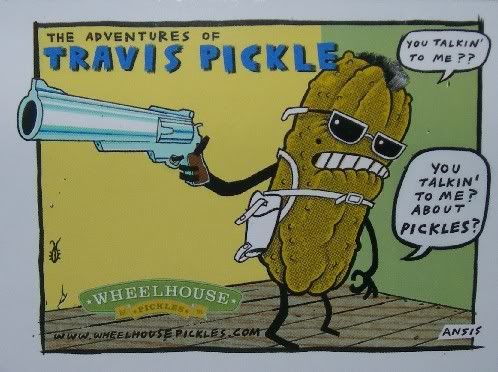
you dont wanna mess with him they might shoot box
|

| Uncle Mertog
October 4, 2007
6:32:43 PM
Entry #: 2402657
| Now that is one bad mutha fuckin pickle!
|
|